

The Federal Horticultural Show (BUGA for short) is a major German exhibition that takes place every two years in different cities, focusing on horticulture and landscape architecture.
The 2031 Federal Horticultural Show is intended to be a project by and for all residents of Wuppertal! That is why it is important to us to involve Wuppertal residents as closely as possible in shaping the BUGA.
In Wuppertal, the Core Areas, the Co-Areas, and BUGA+ form the three pillars of the BUGA. On this page, we provide an overview of where participation has already taken place, where you can get involved right now, and where participation is planned for the future. The information on this page reflects the current status of our planning. In the future, additional project pages will provide detailed information about the respective projects and opportunities for participation!
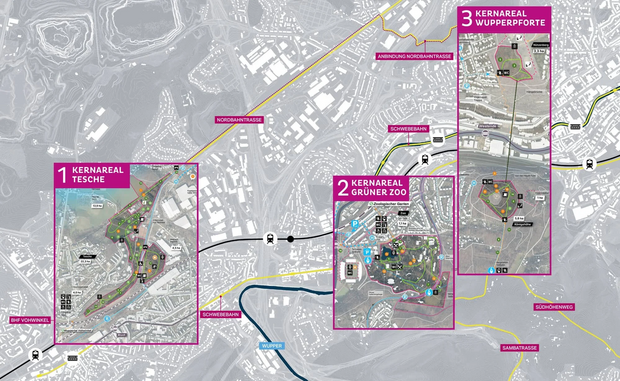
The core areas are the central locations of the 2031 Federal Horticultural Show in Wuppertal. A wide variety of activities will take place here during the BUGA—such as flower displays, themed gardens, events, and activities. At the same time, many of these sites are designed to have a lasting impact even after the BUGA ends—for example, through new paths, green spaces, or facilities such as a cable car or a suspension bridge. The core areas thus combine temporary experiences with sustainable changes for the city and its residents.
Residents of Wuppertal will be able to participate in the design of the following three locations within the core areas. We will develop the exact details of the participation formats in the coming months and then publish them here.
The tree population of the former nursery is being transformed into an urban wilderness through controlled succession. This exciting jungle is accentuated by supplemental plantings of climate trees. The climate tree arboretum showcases the potential of these species for the future and creates a park space offering a rich experiential value. Its extraordinary backdrop provides the setting for the large valley playground “Wilde Gärtnerei.” The design playfully references the structure of the greenhouse complexes. Play cocoons resembling exotic flowers are integrated into the imaginative play and climbing structure.
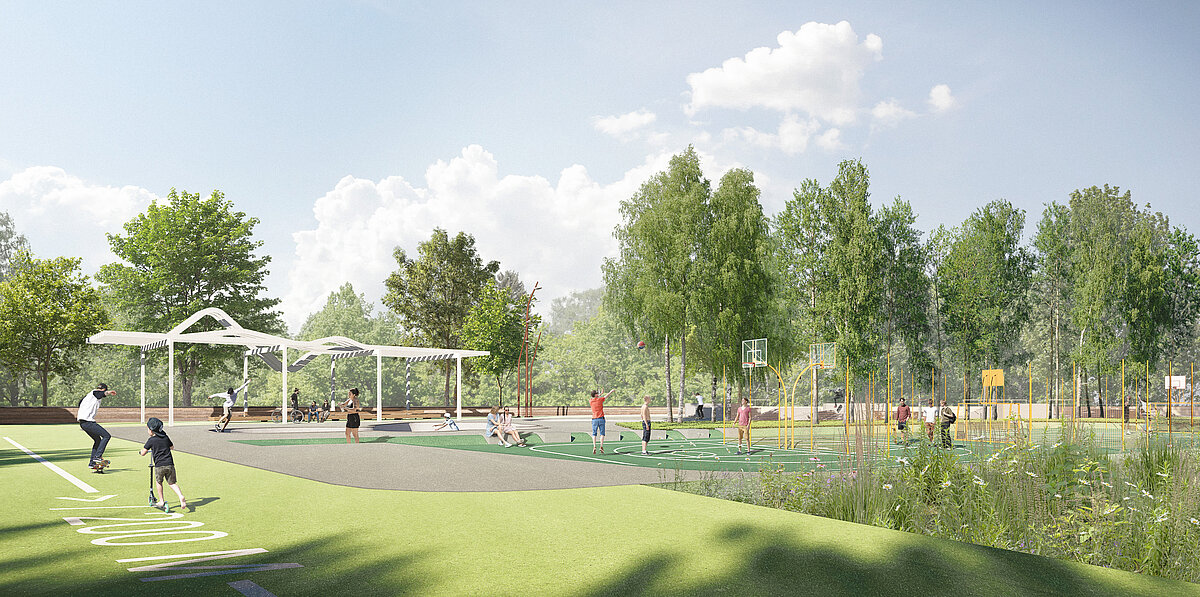
As part of the 2031 Federal Horticultural Show (BUGA31), a sports park is to be built on the Tesche core site. The former “Wassack” brownfield site will be transformed into a sports park offering a diverse and inclusive range of sports and recreational activities.
Last year, the firm “relais Landschaftsarchitekten” submitted a design for the BUGA31 sites and won the open-space planning competition. Part of this winning design is a proposal for the sports park.
This design forms the basis for further planning. That’s why, in September 2026, we’d like to hear from you about which activities are particularly important to you, what ideas you have for the individual areas, and what you think should be taken into account in the further planning.
All feedback will be evaluated after the survey is completed and forwarded to the planning firm. We cannot promise that every idea will be implemented. However, your input will help us further develop the plans and tailor the sports park as closely as possible to the needs of its future users.
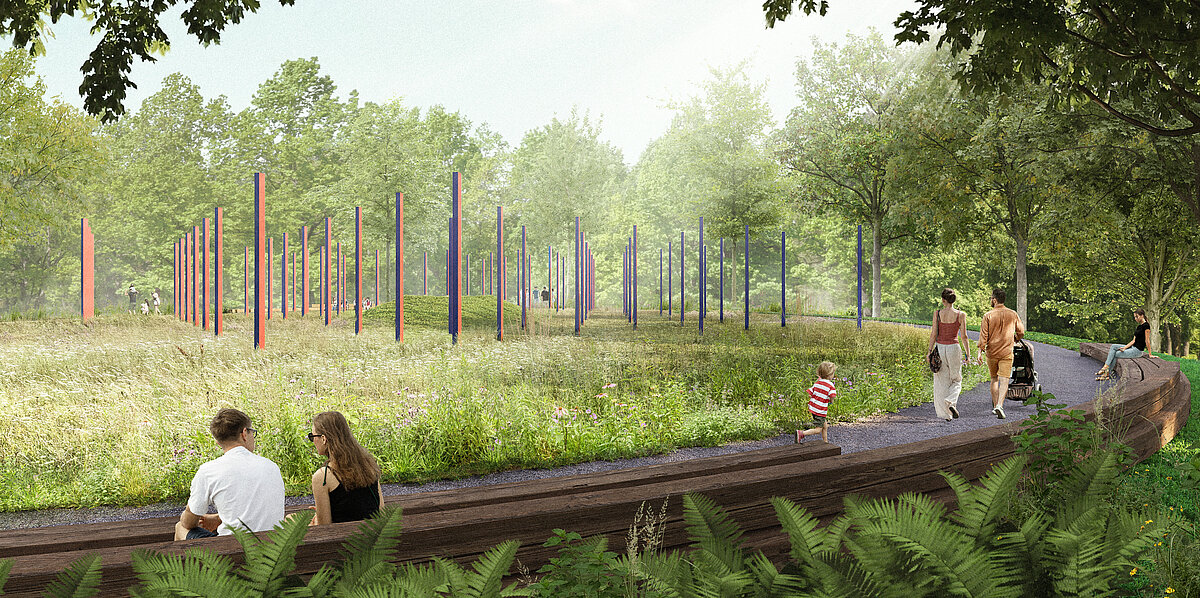
The summit of the Königshöhe can be experienced as a continuous forested area. The circular meadow clearing around the elevated water tank creates an archetypal stage space. It is accessible via an open staircase and an accessible path. This focused spatial arrangement serves as an “art clearing” featuring rotating land art installations.
The image is part of the winning design and does not reflect the final plans.
Formal Participation in Urban Land-Use Planning
The public participation processes just mentioned are examples of voluntary citizen participation. In these cases, the municipality is not legally required to involve citizens.
The situation is different in the context of urban land-use planning. Urban land-use planning defines how our city is to develop in the future. For example, it determines where construction is permitted, which areas are to be protected, and how new residential and/or commercial areas will be developed. In order to implement the BUGA as planned in the core areas, zoning plans must be drawn up and the land-use plan must be amended in some places.
Public participation is required by law in the context of urban land-use planning. Citizens have the opportunity to get involved early on, provide feedback, and submit suggestions. You can find more information on current public participation opportunities related to urban land-use planning here.
The valley station is planned as a combined cable car and parking garage facility at the parking lot on Boettingerweg—between the stadium and the zoo. From there, it will run up to the Königshöhe with a stop along the Sambatrasse. Near the Von-der-Heydt Tower, there will be an entrance to the suspension bridge, which is intended to provide the first-ever pedestrian connection to the Kaiserhöhe.
Both projects require the adoption of a development plan as well as an amendment to the land-use plan:
Suspension Bridge
Development Plan 1294 – BUGA 2 / Suspension Bridge – with Land Use Plan Amendment 166
Cable Car
Development Plan 1257 – BUGA 3 / Valley Station and Cable Car – with Land Use Plan Amendment 169
Public Participation Meetings
Wednesday, June 4, 2025, 6:00 p.m. at City Kirche Elberfeld,
Kirchplatz 2, 42103 Wuppertal
Tuesday, June 17, 2025, 6:00 p.m. in the Council Chamber – Barmen City Hall,
Johannes-Rau-Platz 1, 42275 Wuppertal
Thursday, July 3, 2025, 7:30 p.m. at the City Church Elberfeld,
Kirchplatz 2, 42103 Wuppertal
The plans call for initially creating traditional exhibition spaces for gardens and plants on the Tescher Wiesen, which will be preserved as a permanent local recreation area for the public after the BUGA concludes. The Wassack landfill, on the other hand, is to be transformed into a modern urban sports park that will offer a variety of sports and recreational activities as well as a multifunctional space for smaller events.
These projects require the adoption of a development plan as well as an amendment to the land-use plan:
Tesche
Development Plan 1292 – BUGA 1 / Tesche with Land Use Plan Amendment 161
Wassack Landfill
Development Plan 1299 – BUGA 4 / Wassack Landfill
Public hearing
, Monday, March 23, 2026, at 6:00 p.m. in the community hall of the Evangelical Parish of Vohwinkel
, Gräfrather Straße 15, 42329 Wuppertal
The development of the so-called “Lokschuppen” site in Vohwinkel is currently one of the largest urban development projects in Wuppertal. The former railroad site is to be developed into a residential neighborhood and will serve as the starting point for the exhibition grounds during the BUGA.
The site was originally owned by the railroad. However, it was taken out of service, and the former roundhouse was demolished in 2014. With the planning of the BUGA, the site has come into focus. The plan is to create a new, low-traffic residential neighborhood with approximately 450 residential units in multi-story apartment buildings. The eastern section of the planning area is to be used temporarily as an exhibition space and will not be developed with apartment buildings until after the BUGA. As part of the BUGA, a public neighborhood park will be created on the site, which will remain after the BUGA and be integrated into the future residential development.
To implement the project, a zoning plan must be drawn up and the land-use plan must be amended:
Development Plan 1212 – BUGA 5 / Locomotive Shed Site –
, repealing Development Plan 170 – Nathrath – and
, partial repeal of Development Plan 169 – Nathrath –
and
Land-Use Plan Amendment 94 – Locomotive Shed –
Public Participation Meetings
Monday, May 18, 2026, at 6:00 p.m. and on
Monday, June 1, 2026, at 7:00 p.m.
Both events will take place at the community center of the Evangelical Church “
” at Gräfrather Straße 15, 42329 Wuppertal
Co-Areas are locations in Wuppertal that are being further developed in connection with the 2031 Federal Horticultural Show. Unlike the core areas, they are not part of the traditional BUGA exhibition spaces. Rather, they are scheduled to be completed by 2031 and are intended to drive the city’s development beyond the duration of the BUGA 2031 exhibition.
The Nützenberg Park in Elberfeld-West is to be further developed as a co-site as part of the Federal Horticultural Show through 2031. For example, the sports field will be transformed into a multifunctional sports park. The “Nützenberg” co-site is directly adjacent to the BUGA core area, which includes the planned entry and exit points for the suspension bridge. The co-site will remain freely accessible even during the BUGA.
We’d like to learn how you currently use and experience the park. What do you particularly like? Where do you see room for improvement? Please take part in our online survey between September 4 and 25. During the same period, postcards will be available in the park; you can write on them and drop them in the mailboxes on site. On September 12, we also cordially invite you to a small event at Weyerbuschturm Square.
Your ideas and suggestions will help us tailor the park’s future design to the needs of its users. After assessing their feasibility, we’ll incorporate your ideas into the park’s redesign.
Stationsgarten and Lienhardplatz are the main gathering spots in Vohwinkel—places to meet up, celebrate, take a quick break, stroll through the market, find a sunny spot, ride the carousel, have a toast, grab a bite to eat, find a shady spot, run around, sit down, and then move on.
But are these places today suited to being all that—and more? What can Lienhardplatz and Stationsgarten offer? And what will they need in the future? In the summer of 2026, landscape architects will present proposals for what Stationsgarten and Lienhardplatz could look like tomorrow.
To incorporate the expertise of Wuppertal residents into the planning process, an online survey was conducted from May 20 to June 10, 2026, and on June 6, we held an open workshop at Lienhardplatz.
You can find more information on our project page.
BUGA+ refers to projects initiated and implemented by citizens, organizations, or institutions—outside the central exhibition areas. They complement the BUGA in a decentralized manner throughout the city and enhance participation in and visibility of the garden show across Wuppertal. Partial funding from the city or BUGA 2031 gGmbH is possible. In the fall of 2026, we will decide exactly how this third pillar of BUGA will be implemented. BUGA+ is then expected to launch in 2027 with a call for project ideas.
The 2031 Federal Horticultural Show (BUGA 2031) is a major urban development project for the entire city of Wuppertal. To successfully promote this project to the public, the Association of Friends and Supporters of the 2031 Federal Horticultural Show in Wuppertal e.V. is looking for dedicated individuals to join our team as BUGA ambassadors. As an ambassador, you’ll represent BUGA 2031 at a variety of events, bring innovative informational tools—such as VR headsets and other materials—to the public, and serve as a point of contact for questions about the project. You’ll actively help sow the seeds of opportunity, grow together, flourish together, and reap the future of our city.
You can find all further information at bugatal2031.de.