

Between 2023 and 2025, the square at the Kolk was used and redesigned in several stages as part of the InnenBandStadt project. The special feature: The redesign developed over the course of the project and was not planned from the outset. Initially, it was only used as a parking lot for one week.
The implementation took place gradually and was open-ended. Although the district council had already decided on a provisional, car-free design in 2021, the fact that this could be implemented as part of InnenBandStadt was only made possible by the positive response to the first intervention in 2023. From autumn 2023 to spring 2024, the use as a market square was then also tested for the first time.
After the market vendors left the square again at the beginning of 2024, new options for a car-free design were sought. Over the summer of 2024, various citizens, associations and cultural workers implemented their own projects as part of a disposition fund. Subsequently, a redesign was planned and implemented in 2025.
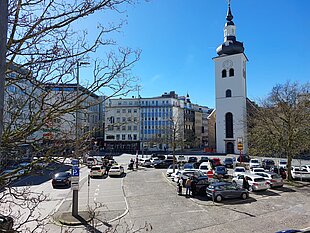
The Platz am Kolk is historically a gap between buildings. The buildings that stood there were destroyed during the Second World War. After the war, the rubble was filled in and the surface thoroughly sealed to create a parking lot.
In 2018, as part of the city center quality campaign and the resulting integrated urban development concept (ISEK), a permanent transformation from a parking lot to a town square was discussed. Such a town square should strategically serve as a "hinge" between the Hofaue district with the future Pina Bausch Center and the pedestrian zone
A permanent redesign of the square at Kolk is planned in ISEK Elberfeld 2019. Due to the many other measures in Elberfeld, this will not be possible until the 2030s.
In 2021, the Elberfeld district council decided that the square should also remain temporarily car-free. However, no funds were initially available for this.
2023 The inner city development project "InnenBandStadt" was launched. The aim was to strategically address Wuppertal's special situation with its ribbon-like structure of inner-city space between the city cores of Barmen and Elberfeld. The aim was not only to work theoretically, but also practically and thus visibly in the urban space.
With this in mind, the overall InnenBandStadt project was visibly launched in summer 2023 with an initial one-week redesign of the square.
The first intervention in 2023 was a test, an initial suggestion of what a redesign could look like. Initial reactions were collected on how people would react to the parking lot being removed. Passers-by were able to leave a rating online using a QR code. 61 ratings were left. Of these, 57 were rated "very good". The results served as an incentive to continue working on the car-free design. The city leadership decided to extend the campaign to eight weeks.
The intervention also served to illustrate what a real-world laboratory can be. As part of the InnenBandStadt project, a "real-world lab disposal fund" was set up at the beginning of 2024. This gave citizens, associations, initiatives, etc. the opportunity to apply with an implementation-oriented project. These were then funded at a rate of between 50% and 100%. The applications were not limited to Platz am Kolk alone. However, four projects took place on the square in summer 2024. The largest of these projects was the Pop-Up-City-BUGA organized by the BUGA-Förderverein. Within a month, a stage was set up on the square and a programme of events ranging from nesting box building to outdoor yoga was organized.
In terms of participation, the real-world laboratories served to enable citizens, associations and initiatives to develop their own inner-city projects. For Platz am Kolk, the aim was to show what activities are possible on the square.
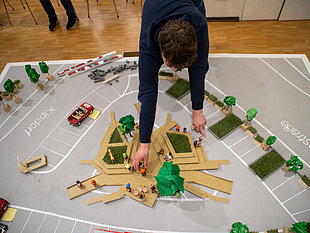
After the square had already been used intensively in 2023 and 2024, funding was still available through the InnenBandStadt project to realize a car-free design in the medium term. A long-term redesign (with civil engineering) is to be implemented in the 2030s as part of urban development funding. To bridge the period between 2025 and 2030, a planning and implementation process was initiated. A landscape architecture firm submitted a proposal. This was then presented, discussed and qualified at two participation events.
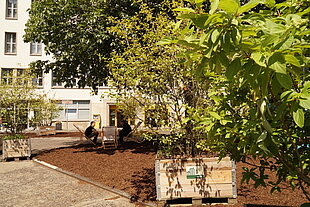
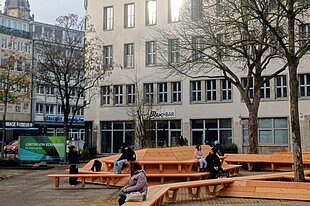
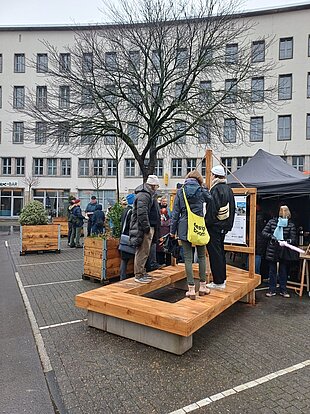
The participation results for the redesign in 2025 were taken on board and incorporated into the implementation as far as possible. For example, seating was installed at different heights on the sides of raised beds to provide seating for different target groups. The redesign is barrier-free. In terms of materials, a great deal of attention was paid to slip resistance and garbage cans were added. The landscape of footbridges can also be used for play. Unsealing was examined, but was not possible given the available resources (time and money) and the expected expense (sealing with asphalt, concrete slabs and bitumen; possible ground monuments and contamination).
The activities involving Platz am Kolk were observed and evaluated as part of the strategic examination of Wuppertal's city center. The findings are presented in the final documentation .
The redesign idea for the square was discussed in spring 2025 as part of a participation process. Following the feedback, the plans were revised until they were ready for implementation, a tender was issued and the plans were implemented by November 2025.
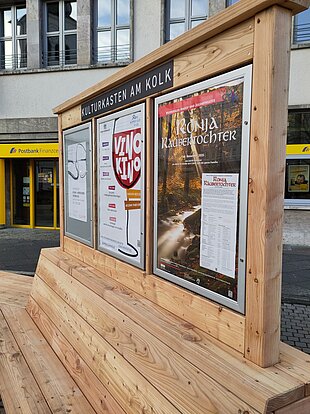
Three raised beds and a platform (stage, seating and lounging element) with attached and cantilevered walkways have been created. The walkway elements on the sides of the raised beds serve as seating. Due to the different heights and the cantilevering, they can also be used by children for climbing and balancing. Several hundred plants were placed in the raised beds and three additional trees were planted alongside the existing trees. European larch, a native wood, was used as the building material. In order to make it easier to recycle the wood in the event of a final conversion, the wood was not painted except for a few color accents. The natural graying fits in with the design concept. A cultural information box was built next to it. This is used - supported by a neighboring arthouse cinema - by the cultural institutions in the area to present productions and events. Bicycle racks were also installed and a parking space for e-scooters was marked out.
Tobias Ringel
Department 101 Urban development and urban planning
tobias.ringel@stadt.wuppertal.de
Phone:0202 563 6482